Flikr Photostream

Created with flickr badge.

Friday, May 10, 2013

Devon Lions Campground

Preserving the Park

In the last few years, according to the Devon Lions and the Lions Campground Management, it is estimated that 6 to 8 feet of shoreline has been lost, in particular, in the area adjacent to the Campground office.  This, however, has never been actively marked nor measured for the purposes of quantification.  

Empirically, we are left with areal analysis to approximate rates of erosion.  Locals also point out the dogleg area of the roadway, being in greatest proximity to the river bank, as having significant potential for negative operational impact to the Devon Lions Campground.  This is the area widely considered to be of critical importance.


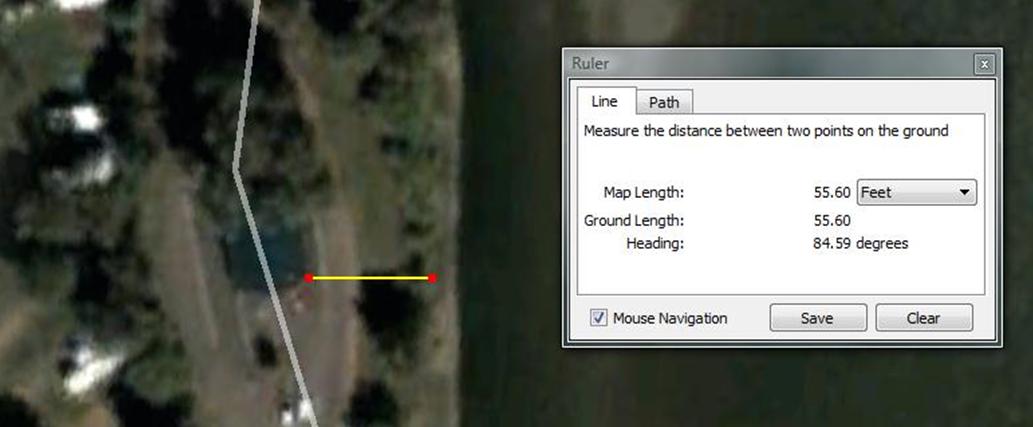
This area presents a significant concern due to the potential for interruption of traffic flows and normal operations of the campground.  An approximation of distance from top of bank to nearest roadway construction at the time of this photo was approximately 6.1 meters (approximately 19.7 feet), it has likely degenerated to a modest degree since the time of this areal image.  A foot inspection with GPS coordinate capture will establish baseline data starting in 2013.

Given the low average of erosion over the last two years (in accordance with local knowledge), the timeline for the expected impact of operations, all else equal, would be some years away.  Using the 4-year longitudinal average at a rate of .7025 feet per year, the declination would be calculated as: (19.7 / .7025 = 28).  Enhanced flow level years, when overtopping occurred, are not believed to be included in the four-year comparison.  In general, it's safe to say the dogleg road area isn't likely to wash out this year or even next year, even when adjusting for shoulder easement and safe foot travel area.

Erosion accelerates by a combination of volume and rate of the flow in the river.  In other words, the amount of water and how fast it flows has a powerful impact on the erosion rate.  Overtopping the bank, i.e. "the big flood", is a rare event and unlikely to cause substantial damage due to the overtopping itself.  Instead, it is the power of the river and the rate of river flow sustained during overtopping events that would have the most powerful impact on erosion.  This, of course, is why precipitation levels and dam release are central to a root cause analysis. 

Extraordinary flooding circumstances create some amount of erosion.  Project engineers from both commissioned firms, Peregrine and EBA, agreed when asked directly, that it is the quantity of water and the flow rate of the water, as controlled by dam release, that has, by far, the most considerable impact.

Geotechnical analysis should be focused on the area near the cabin, the dogleg, and the area with the minimum extent of bank coverage.  These were the sentiments agreed upon by the Lions in conjunction with the meeting of the Town of Devon representatives.  Upriver conditions were examined; visual inspections did not report visible tension cracks.  EBA states there is no risk of imminent riverbank failure.  The main roadway in the campground could be compromised to traffic well before the riverbank erodes to the point of contact. 

Most erosion occurs during the major water release periods from upriver dams.  This may happen in conjunction with heavy precipitation events or during times of high snowmelt and glacial melt.  Environment Canada records show the majority of precipitation is recorded from May through September.  Spring melt combined with substantial precipitation events probably carries the highest potential for overtopping.  The Peregrine consultant corroborated this information during her immediate post-inspection visit and site de-brief.


Google Earth shots available to the public were used for riverbank erosion "rough" analysis.  Two data points by Google Earth applicable to this area were drawn from 2004 and 2008 data.  A line was drawn from the bottom (SE corner of the Cabin directly to the riverbank at approx. 85.xx degrees < 1-degree variance and compared between the years 2004 and 2008.  The year 2004 shows approximately 59.23 feet and the 2008 image shows approximately 55.6 feet.  The rate of declination over the four-year period approximated at 3.63 feet. 


A second analysis was done using a fixed infrastructure point.  In this case, the measurement was centered on a fixed point and extended to the top of the bank as imaged overhead.  The reduction of terrain appears to be approximately 2.81 feet in this case.  The rate of bank erosion varies from area to area.  Compensation was applied for a < 1-degree variance, generally compensated by selecting an anchor point in line with extended vegetation and a clear demarcation of bank shading, indicating the exposed face of the riverbank. 

Again, heading variance accounts for a minor distance variance, probably less than a couple of inches.  This measurement is subjective on the riverside anchor point due to vegetation changes and interruption of overhead resolution of the image, yet it is probably a fair indicator.  Close examination also reveals lost vegetation, although the major trees appear to remain intact.  This could be the result of pruning or the result of smaller vegetative features eroding into the river.  It is impossible to detect this with low-resolution satellite imagery and the measurement should only be considered a very rough estimate.


It seems unlikely that erosion rates would be consistent along the course of the area under study, and the predominant hydrological factor affecting the rate would probably be the evident sand bar that exists in the river proximal to the area of the cabin.  Intuitively, it appears to have the effect of slowing the rate in that area.  As the river flow rate slows, sediment tends to fall out or "sink" which would create and sustain a feature like this sandbar. 

As the river passes that zone and proceeds down the river, it seems to pick up speed, thus predictive of a more rapid rate of recession in the downriver area.  This presumptive estimate seems to have been borne out by measurements.  The EBA study focused on the same area provides no analysis as to the rate of declination of the land area.  Their overhead imagery is the same source (Google Earth) with imagery taken from the 2008 posting of Google Earth.  The EBA study had no year-over-year comparisons or period-over-period analysis.  Although the bottom right corner of the image shows "2012", this refers to the access year of the image by the Google Earth user.


The third area of analysis was set on the distal area of the driving road anchored in the central traffic division feature that existed at both points in time.  The 2004 image shows approximately 87.96 feet compared to the 2008 image at 81.71 feet, or approximately 5.25 feet of recession.  Once again, the downriver portion of the river study area appears to be showing a gain in velocity.  In Saskatoon, a confluence near an erosion riverbank area seemed quite similar to Washout Creek and suggested potential interplay with erosion rates near the confluence with the North Saskatchewan, potentially introducing another hydrological feature into the mix that could create increased bank instability, which, as noted above, has been an ongoing issue in the Saskatoon region.


The Bighorn dam created Lake Abraham, Alberta's largest man-made lake.  The Bighorn Plant generates enough electricity to supply the equivalent of 58,300 Alberta households.  The Bighorn embankment dam was built in 1972 in the mountain gap at Windy Point, in the Front Ranges of the Canadian Rockies, west of the confluence of the North Saskatchewan River and the Bighorn River, and is managed by TransAlta.

The Brazeau Dam is located in Brazeau County of Central Alberta, 55 kilometers (34 mi) southwest of  Drayton Valley.  It was developed along the Brazeau River, at the confluence with Elk River, in the hydrographic basin of the North Saskatchewan River.  The Brazeau Dam is managed by TransAlta and produces 394,000 MWh per year, with a capacity of 355 megawatts. 

Since release from the Bighorn and Brazeau are, in times of large precipitation, largely interdependent,  the impact of water level and velocity are directly influenced by these two dams.  There are many factors that govern water release.  The upriver dams would both have a considerable impact on flow rate and quantity.

The North Saskatchewan River is subject to the 1969 Prairie Provinces Water Board Master Agreement on Apportionment (PPWB), which states that Alberta must allow 50% of the natural flow of east-flowing rivers to enter Saskatchewan.  It also prescribes the minimum flow required and water quality objectives (Alliance).  It is likely to release rates would be managed, in part, by the PPWB master agreement.

The EBA project engineer who previously worked on the Shaw Conference Centre armoring, and a City of Edmonton official, both indicated there has been no effective way to generate release agreements designed to mitigate erosion between hydroelectric operators and individual municipalities.  It seems unlikely Devon would fare any better.  In addition to the requirements of the PPWB Master Agreement, there are commercial considerations for power generation.  

Erosion appears blunted near the cabin due to the projection of the pronounced sandbar.  This is evidenced in the 04-08 erosion rate of 3.63 feet.  The natural velocity of the river should tend to be slow immediately proximal to the downriver side of the sandbar projection and then accelerate as it progresses past the cabin area.  This, in turn, should present by way of further erosion rates on downriver trend as is borne out by the 2004-2008 findings that show a similar rate of erosion at the dogleg of 2.81.  Cabin and dogleg measurements are similar for rates of erosion. 

The river apparently begins to pick up speed at the third measurement point, advancing to a rate of 5.25 feet over the same period of time.  These measurements can be precisely calculated via surface GPS release floats, undercurrent speeds may also be calculated in a similar manner.  The findings corroborate intrinsic knowledge and logical inference.  Some flow rate and river level historical records may be consulted to examine concerns of overtopping due to severe floods.  Some photographs of overtopping events have been brought forward by local residents.

There are unknown hydrological implications of the washout creek confluence and the interplay of aquifer recharge upstream of the confluence.  Recharge influence over lateral instability could logically result in an alluvial presentation of erosion proximal to the confluence.  Local knowledge suggests there may exist one overflow pipe system for confluence drainage, probably designed for overtopping mitigation of Washout Creek.  Documenting and evaluating this drainage system may turn out to be an activity with merit.

The City of Saskatoon has battled riverbank erosion since the early part of the 20th century.  Numerous studies have been commissioned along with a variety of remediation efforts.  Much of their efforts have surrounded subsurface drainage systems in combination with berming of slopes and armoring of the riverbank.  Their situation is largely influenced by the rate, flow, and discharge of urban-influenced surficial aquifers and regional aquifers (A.W. Clifton, 1980).  Saskatoon has obtained favorable results with berming and riverbank armoring. 

To my knowledge, a stratographic assessment of the Lions Campground has never been done, which precludes an understanding of aquifer recharge implications relative to stratographic identification of potential erosion or "slide" areas.   There may be some merit in considering a stratographic assessment of drift and underlying till.  An image of the stratographic assessment of the 18th Street cross-section from Saskatoon is included as a reference.


It is possible an inferred slip zone could be negotiated scientifically, but it should also be noted that an intrinsic geologic understanding of this area could rule out the need to undertake such an assessment.  Stratographic interpretation has not been discussed by EBA or Peregrine but has been a component of both the City of Saskatoon and the University of Alberta College of Engineering studies cited herein.  In other words, the one integrated science both the commissioned reports did not have.  In the event of overtopping, such an assessment would seem to be more important relative to the inland embankment upon which housing is situated. 

Natural Resources Canada produced a comprehensive geoscape of the Saskatoon area (Canada N. R.).  NRCAN research also described coarse rock berms as a contra-erosion feature leveraged for bridge protection in low-lying areas, which is in line with coarse rock berm armoring undertaken at the Shaw Conference Center.  Appropriate geological advice prior to discarding the idea of a stratographic study out of hand might be warranted, although it seems unnecessary to our goal of protecting the campground from lateral erosion of low-lying areas and preventing the loss of corresponding parkland features of the campground.


Geoscape contextualization demonstrates the integrated science approach to erosion analysis (Canada E. ).  Conducting a spatial imaging pattern recognition analysis of the river might be warranted.  This could be attained through the Government of Alberta archives for imagery and possibly accessing data from the Spatial Information Systems Laboratory (SISL) at the University of Alberta.  Academic dialogue with leading hydrological, geotechnical, geological, and geophysical resources should not be discarded out of hand when it is possible for the SISL could provide access to GIS data and mapping software at little to no cost with possible collateral interactions with multidisciplinary scientists.

One thing is certain; we are not alone.  Edmonton's river valley has also been the subject of considerable study.  In every study related to riverbank erosion that I have consulted, they have all included stratigraphic and topographic considerations of relative geology in the immediate area of concern.


Referenced is a study undertaken by the University of Alberta in conjunction with the physical expansion of the University.  The study was headed by the Dean of the College of Engineering (S. Thompson, 1978).  The conclusion of that report spoke directly to lateral erosion.  The University of Alberta, the Shaw Conference Centre, and the City of Saskatoon implemented berming and riverbank armoring.  In the case of the University of Alberta, riprap facing was employed using a variety of sizes.  The sizes were carefully selected depending on calculated erosion forces given estimated flow rates.  The University of Alberta also concluded that lateral meandering is more significant than valley downcutting.

The University of Alberta study noted the economic cost of riverbank stabilization work to be substantial.  The annual cost of riverbank stabilization approaches the value of land protected, thus they argued the only case that justifies such measures would be those instances where it would impact public use and recreational activities… as is the case in Devon.

The Town of Devon and the Devon Lions Club are two highly impacted stakeholders.  As such, the Devon Lions Club has appointed by resolution of the General Membership, two representatives to liaise between the Devon Lions Club and the Municipality.  Areas of primary concern and action items outlined by the EBA study focus on continued bank monitoring and structural engineering analysis of the existing walls and bank protection mechanisms to insure ongoing stability.  Plans are being developed to protect the campground from further bank erosion through the measure of adding "armoring" to the riverbanks.

The Town of Devon and the Devon Lions Club are two highly impacted stakeholders.  As such, the Devon Lions Club has appointed by resolution of the General Membership, two representatives to liaise between the Devon Lions Club and the Municipality.  Areas of primary concern and action items outlined by the EBA study focus on continued bank monitoring and structural engineering analysis of the existing walls and bank protection mechanisms to insure ongoing stability.  Plans are being developed to protect the campground from further bank erosion through the measure of adding "armoring" to the riverbanks.

After considerable independent research, I agree that vulnerable zones should receive armoring, although the riprap should be properly determined as per the University of Alberta study.  Given my knowledge of the beliefs of the local people, I think armoring the high-risk sites, namely, the cabin to the dogleg area would alleviate the highest concerns while protecting against the most expensive issue, the potential relocation of a roadway.  It is probably wise to explore an initial armoring phase in this area.  This would be a highly visible project providing physical reinforcement.

Riverbank armoring may not actually require approvals of other levels of government so long as the equipment used to undertake the armoring is not required to enter the river properly.  This should be investigated at the outset of any planning to prevent any possible issues with other levels of government.

Both consultants suggested low precipitation months as being optimal for work schedules.  Materials may exist by way of the Town of Devon sidewalk and curb replacement program rubble, or some form of riprap, appropriately sized and suitably esthetic.  Given the timelines, a planning phase could extend from early 2013 to late Spring 2013 or Summer, so as to accommodate public input and leverage a consultative process.  This would allow time to undertake ingress/egress arrangements to the riverbank at project commencement.  When river flow reduces in the Fall or early Winter of 2013/2014, work could be undertaken. 

Major improvements could be budgeted across fiscal years, with long-range ongoing investment through the 2014 - 2017 range if deemed feasible.  Further, a member of the Lions Club noted there was a pathway on the riverbank.  Given the River Valley Alliance (RVA) funding and the pre-existing path structures that connect the RVA, there may be some partial offsets to bank stabilization expenditures. 

There have been some discussions relative to making other changes in the River Valley.  These include an extension of the existing boat launch or possibly the addition of another boat launch.  Whatever these plans are, some amount of consideration should be given to those plans so that any work was undertaken to prevent riverbank erosion would not create undue conflicts with future projects.  

Cited 

A.W. Clifton, J. K. (1980). Riverbank instability and development control in Saskatoon. Saskatoon: 1980.

Alliance, N. S. (n.d.). About the Watershed. Retrieved November 21, 2012, from North Saskatchewan Watershed Alliance: http://www.nswa.ab.ca/content/about-the-watershed

Almanac, F. (n.d.). 2013 Long-Range Weather Forecast for Edmonton, Alberta. Retrieved November 21, 2012, from Farmers Almanac: http://www.almanac.com/weather/longrange/AB/Edmonton

Canada, E. (n.d.). Environment Canada. Retrieved 11 18, 2012, from National Hydrological Resources Centre: http://www.ec.gc.ca/scitech/default.asp?lang=En&n=44EEFEB3-1#nhrc

Canada, N. R. (n.d.). The Trouble With Valley Slopes : Landslides. Retrieved 11 28, 2012, from Natural Resources Canada Earth Sciences: http://www.nrcan.gc.ca/sites/www.nrcan.gc.ca.earth-sciences/files/pdf/sask/pdf/geoscape_southsask_landslides_e.pdf

EBA - A TERA TECH COMPANY. (2012). Riverbank Erosion and Stability Assesment North Saskatchewan River. Devon: A.F. (Tony) Ruban, M.Eng., P.Eng., Brian C. Adeney, P.Eng.

S. Thompson, D. T. (1978). River erosion and bank stabalization - North Saskatchewan River, Alberta. Edmonton: Department of Civil Engineering, University of Alberta.


Saturday, November 10, 2012

Veteran's Day Message 2012


Veteran's Day Message 2012


Fresh from the excitement of the U.S. Election, I'm pleased to see the democratic system of the United States transition power (in this case retain it) in a peaceful manner as has been the hallmark of the great union since George Washington rejected the notion of being a King or President for life.

George Washington left his service as President imparting words of wisdom to the new nation… among those words, he said, "The basis of our political systems is the right of the people to make and to alter their constitutions of government. But the constitution which at any time exists till changed by an explicit and authentic act of the whole people is sacredly obligatory upon all".  Clearly, President Washington was a man who understood the value of democracy and the rights of the people.  He was also a man who suffered terrible hardships of war to enshrine those values. 

In the United States election, I watched as partisan politics generated a fever pitch in the months leading up to the election.  Even the news channels seemed to have a stronger partisan flavor than usual.  Immediately after the election, the conversations quickly turn to the problems ahead and how there will be a great conflict in a nation so evenly divided.  In part, this is probably due to the pain of defeat, which is very real.  Especially for the candidates and their campaign workers and the thousands of volunteers who have placed countless hours of their lives into a cause they dearly believed in.  But the pain of an election defeat quickly dissipates and the business of the union continues.

I always harbor a strong sense of optimism at election time because I would like to believe that true patriotism is always prepared to blossom in the hearts of those who will head to Washington to govern the nation.  Patriotism itself should guide the larger needs of the nation and infuse a sense of collaboration in all hearts.  But the optimism, like the pain of defeat or the ecstasy of victory, also tends to dissipate as the omnipresent tasks ahead of the people are ever larger and more complex in a shrinking World.

The optimist believes the best days are still ahead of the United States.  President Obama will be focused on shaping the policy environment that will usher in new jobs, a growing economy, and a shrinking level of military conflict around the World.  Of course, the challenges are not easy nor will they be solved overnight. Hopefully, words of optimism and courage shall guide the republic and be a constant companion of political leaders in the weeks, months, and years ahead. 

On a personal note, I'm cheering for President Obama because, Like former President Clinton, I believe his policy direction will pay dividends for the great republic.  The global economic and security challenges this administration has faced have been historic.  The President, however, is not without fault.  During his first two years in office, he tended to undervalue the coin of the realm… trust.  Trust between Republicans and Democrats alike.  Politics do not need to be a blood sport.  People who do not involve themselves with the machinations of the political intricacies of the beltway believe their representatives are assigned the job of looking after the republic and that they will do that work to great effect. 

There will always be a reason to distrust the patriotism of those who, under any pretense, may endeavor to weaken its bonds.  The division of political beliefs has spanned ever wider, creating large chasms that may disturb the republic.  It is clearly a matter of great peril, that any circumstances should be furnished for characterizing parties by demographic or geographic discrimination. 

The manipulative leaders of divisive policy endeavor to excite a belief that there is a real difference of interests and views. This is an expedient manner for a party to acquire influence within particular districts or parties.  Altogether too often, they will readily misrepresent the opinions and aims of other districts or parties.  Citizens should actively shield their hearts against the jealousies and divisiveness that spring from attempts to divide.  Such actions render hostilities between citizens who ought to be bound together by fraternal affection. 

I point no fingers at any party, instead, I caution people as citizens of the republic, thereby incorporating both the innocuous practitioners and the sublimely effective highly capitalized practitioners for whom financial capacity dwarfs the ability of the average person to compete for an understanding of their opinions.  For the republic to be effective, a union of the government for everybody is indispensable and must be demanded of our elected representatives.

Some political entities exist to organize a strong faction and to endow it with extraordinary force powered by wealth.  The danger of such entities is their proclivity to pretend they delegate the will of the republic while representing the will of their own interests.  In many cases, such entities are driven by a minority of republics, making the public administration the mirror of the ill-concerted and incongruous projects of their self-serving goals.  This is in stark contrast to transparent and well-thought-out plans that are evaluated by common counsels; modified by mutual interests and a sense of the fraternal good for the entire republic.

Unfortunately, the aforementioned political entities will seek to carry a popular issue such that it enhances their ability to become powerful organizations.  Their leaders are often cunning and ambitious.  Left unchecked, their ability to subvert the power of the people for their own purposes endangers the well-being of the republic.  It is only through the constant opposition to such extremism that the public good will be served.

The baneful effects of the spirit of a political party have, as part and parcel of the very human nature of such organizations, the goal of domination over another.  This is sharpened by the spirit of revenge natural to opposing parties or political entities.  Left unchecked, the miseries imposed over the weaker entity, over time, will incentivize people to seek the security of the absolute power of the party or entity, expressed in our current system as partisan politics and control over key institutions. 

Having no recourse, and left to prosper without dissent, leaders of powerful factions, having accumulated more fortune than their competitors, may seek to elevate their powers at the expense of the public good.  Let these words stand as a grim reminder that public interest, the very foundations of democracy, become challenged whenever such polarization is allowed to run rampant over the larger needs of the republic and the people.  As this election ended, leaders on both sides pontificated the need to work across the aisle and engage each other in the spirit of the public good.  May we be fortunate to see these words translated into actions.

I believe the policy issues of the day, such as managing the finances of the republic, restoring geopolitical stability in the Middle East and elsewhere, the restoration of the economic engines that provide jobs, and a thoughtful dialogue about climate change constitute challenges every bit as large as the greatest challenges the republic has ever faced.  In few instances, except during the great wars or during the civil war when the cousins battled each other for the very existence of the union itself, has more been at stake for the people of the republic.  Accordingly, it is up to the people to demand, through their votes and their constant attention to government, a non-partisan spirit that shall not wane with the passing of some weeks or months. 

This applies equally to all parties and political entities, all of which owe their very right to exist to the blood of the patriots shed across the centuries.  Let the sacrifice of the many patriots be cherished and valued, for in their sacrifice the republic came to exist and survives to this day.  Failure to arrive at political solutions for the overall public good, even at the expense of the power of the political party or entity, is to heap the ultimate disrespect upon the cherished memories of the many patriots who have fought and paid with their blood and with their lives, for the free republic that now faces these challenges.

I wish every success to the President of the United States, to his staff, and to the Congress as the elected representatives of the people.  And I'm equally sure that, in the most fundamental sense of patriotic duty, this is also the wish of the people of the republic.  I also admonish both parties for their partisan mischief over the last years, and I am very hopeful their desires for the future of the republic can, and shall, be placed above any and all forms of partisan posturing.

As it turns out, this is a rather rare election for me because the President is also my cousin.  President Obama and I are 9th cousins, two times removed!  I believe I shall, perhaps, write to the President and ask him to send his cousin some inauguration tickets.  This will likely be the only chance I ever have to see a cousin sworn in as President of the United States for a second term.  But I would also like to look back on such an experience knowing it was also the day a new journey on the path of bi-partisan politics began in Washington. 

Interestingly, our common ancestors are from the Canadian side of our family tree that ties us together as cousins.  POTUS has Canadian lineage he can be proud of!  If I get the inauguration tickets and, possibly, the chance to converse with the President… I'll be sure to point that out to him.

In the meantime, dissolving all such fantasy of inaugural attendance, I turn my attention to the important duties of respecting our honored dead and the glorious living who have made the ultimate contract and compact with their fellow citizens, to defend freedom and liberty at all costs, and to pay any price to insure it, up to and including their own life if necessary.  Let those brave men and women occupy our thoughts as we, the free from around the World, gather to remember and honor these brave people.  Let us remember they have provided the very democracy where we prosper and thrive.  If you know a Veteran, or if you have a Veteran in your family, maybe take a moment to thank them for their service.  Those words mean more than you can ever imagine; it was for you whom they dedicated and sacrificed some of the best years of their lives.

Friday, November 2, 2012

The E-President Poll predicts an Obama Win


In the last U.S. Presidential election, I invented a fun tool designed to measure the e-bay factor.  It's a poll that looks at how much money people are willing to pay to have a piece of the candidate.  The more items for sale the larger the demand.  If the market has a larger demand AND a higher price, it's a hands-down winner. The fascinating part is that it had a 100% predictability record in the 2008 U.S. election, both in the primaries and the general election.

e-President poll is not scientific, in fact, it's about as subjective as you can get.  I just do this for fun.  Still, it seems to have a good track record to predict the Presidency!  So here we go again.  Keep in mind, the last election did not feature a sitting President, so owning a piece of the candidate made for a relatively equal playing field in 2008.  In this election, if you bought Obama, you'd be getting a Presidential autograph and if you buy a piece of Romney, you won't know if it's a Presidential autograph until after the election... could turn out to be the autograph of somebody who ran and lost, so the value is harder to appreciate.  This means more measures should be introduced, so I added active bids.

Active bids are the range where the "buy it now" signs tend to either fall off or we see multiple bids on items with regularity.  In other words, this is where the market becomes quite active for both candidates, indicating a measure of liquidity.  In this area, Obama holds roughly a 4:1 advantage over Romney.  Unfortunately, this is a new measurement, so I can't compare it to the 2008 data.  Obama's Active Bid Range starts just shy of 400 and strengthens into the 350-dollar range whereas Romney starts at 100 and strengthens into the 75-dollar range.  Interestingly, a lot of items for sale this year are signed baseballs.

Active Bid Range 3.99 : 1 Obama


Item count is another category, and compared to the 2008 election, where Obama's item count was 3.7 times higher than McCain's; the range has narrowed in this election with Obama posting 2.8 times the item count Romney has.  This is a troubling statistic for the incumbent president as one would expect an incumbent President's item count separation to be wider.  I think this reflects a much stronger candidacy from the Republican ticket.


Item Count 2.87 : 1 Obama


The value predictor... or how much people will pay to "own" a piece of the candidate has also changed between 2008 and 2012.  Obama's cash value has slipped from 2008 when it was 2,500 down to 2,125 in 2012.  Romney, on the other hand, posts nearly 400 bucks on top cash value pre-election compared to a mere 108 bucks for McCain back in 2008.  This means Romney is a stronger candidate than McCain according to valuation figures. and the ratio has vastly changed down from 23:1 in 2008 to a mere 6:1 advantage for Obama in this election.

Cash Value 6.08 : 1 Obama

My analysis is as follows:

Obama will win the election, although due to lower bid values and a tighter range, and compensating for an incumbency, it looks to be that the polls are correct, this will be an exceptionally close election.  The bottom line will be how the swing states go, and on that count, I believe the map of the United States will look very red, but most of the key swing states will be blue; placing President Obama over the top in the Electoral College, but it could be tight... with a possible electoral college win of less than 30.

A narrow active bid range is also troubling, but I feel the margin is wide enough to make it easy to call the race.  Obama enjoys both a far larger base of active bids and the quality is superior.  Romney, apparently, isn't as easy to sell on eBay.  I was going to try and use Hillary as a potential marker to adjust for incumbent vs. non-incumbent, but even though she is Secretary of State, she is also a failed candidate and her e-bay numbers were in the tank... so not a good way to go.

I'm going to apply a 4:1 rule for incumbent vs. non and look at an amalgamated difference in the ratios posted in item count, valuation, and active bids.  Bear with me... it's a guess.  But using this as my only attempt at a data normalization attempt, I arrive at a predicted victory by Obama of approximately 3.2 (+/- 3)  In other words... it won't be pretty, but Obama wins in 2012.  

Saturday, April 28, 2012

Climate Change and Arctic Methane

Arctic Ocean Latitude 71 degrees North
April 15, 2010, Image Credit: NASA/JPL

I recently noticed a fascinating article in the Edmonton Journal written by Margaret Munro of the Postmedia News entitled "Scientists eager to drill in Arctic Waters for answers about methane".  The article goes on to outline a project being undertaken by the Integrated Ocean Drilling Program for the expressed purpose of gathering a deeper understanding of the ramifications of methane coming out from the permafrost under the Arctic.  


Glaciologists, geologists, and environmental researchers of different disciplines have been pondering very large questions related to the planetary environment and what the potential impacts could be to humans.  Of particular interest recently, is the impact of methane hydrates coming out from the permafrost beneath the Arctic.  Since methane is probably 20 to 25 times more potent greenhouse gas than CO2, there are considerable ramifications associated with this research.  Methane has a short half-life compared to CO2, so it dissipates faster, this offsets the sheer quantities that could be released into the atmosphere.  With estimates of methane hydrates being discussed in vast numbers, understanding the risk imposed by climate change in the Arctic is not a subject to be taken lightly.  


Image Courtesy of:
Gordon Groat
Ph.D.(abd), M.Sc. (hon), M.A., B.G.S. (IPE), A.A.Sc.
Taken from CO2 and Climate Change
According to Gregory Ryskin, associate professor of chemical engineering at Northwestern University, "explosive clouds of methane gas, initially trapped in stagnant bodies of water and suddenly released, could have killed off the majority of marine life and land animals and plants at the end of the Permian era" — long before dinosaurs lived and died. Ryskin believes that methane may have been the driving force in previous catastrophic changes in the earth's climate, where 95 percent of marine species and 70 percent of land species were lost in - geologically speaking - the blink of an eye.

The most troubling estimates suggest that once triggered, this cycle could result in runaway global warming, sometimes referred to as a tipping point.   While our scientific evidence is still limited in scope, it is important to consider what we know from looking back in time.  It seems prudent to be cognizant of strong geologic evidence that suggests something similar has happened at least twice before.  The most recent of these catastrophes occurred about 55 million years ago in what geologists call the Paleocene-Eocene Thermal Maximum (PETM), when methane burps caused rapid warming and massive die-offs, disrupting the climate for more than 100,000 years.  The granddaddy of these catastrophes occurred 251 million years ago, at the end of the Permian period when a series of methane burps came close to wiping out all life on Earth.  More than 94 percent of the marine species present in the fossil record disappeared suddenly as oxygen levels plummeted and life teetered on the verge of extinction. Over the ensuing 500,000 years, a few species struggled to gain a foothold in the hostile environment. It took 20 million to 30 million years for even rudimentary coral reefs to re-establish themselves and for forests to re-grow. In some areas, it took more than 100 million years for ecosystems to reach their former healthy diversity.

Earth image courtesy of:
NASA / JPL
Climate change... if it is anything, it is definitely controversial.  It is also a scientific field that is relatively new and requires additional investment to produce the scope of data required to properly evaluate the impact of methane release.  It should also be noted that methane emissions from tropical areas far surpass, in scale, the emissions of the Arctic.  Nevertheless, methane release due to climate change in the Arctic is worthy of scientific investigation.  The science is not settled on this matter, but it is of considerable importance.  

At the very least, it seems logical to establish baseline measurements of methane in the Arctic simply because the vast potential amounts of methane warrant our investigation for the purpose of understanding changing levels of methane.  This is required in order to reduce the chance of misinterpreting changes in methane levels as climate change continues.

To further understanding of the ramifications of global climate change impacts due to methane release from the Arctic, there is a need to establish increased scientific monitoring and research on the subject.  Rising surface temperatures should motivate the international scientific community to consider these questions.  Appropriate considerations imply the need for the deployment of scientific measuring instrumentation, improved international collaboration, and the integration of traditional indigenous knowledge.  

One particularly revealing comment made by an indigenous elder of the Arctic was "in our generational memory, we have never seen the ice melt so much, we have never seen so much open water".  This prompted the interviewing scientist to ask if that meant one generation or two perhaps.  The question was not easily understood by the elder.  After some more questions, the elder replied that by generational, they meant thousands of years.  This underscores the critical fundamental knowledge carried by the indigenous people of the Arctic.  There are literally thousands of expressions to describe different ice conditions, many of them not easily translatable into English, at least not to their satisfaction.  Thankfully, as research in the Arctic moves forward, more and more participation and collaboration is taking place with indigenous peoples.

This raises the question of what to do with the research.  It's critical to place the best science we possibly can gather into the hands of decision-makers.  The policymakers and governments that have jurisdiction in many areas of the Arctic reside thousands of miles away from the Arctic.  This poses a fundamental problem that can possibly be overcome by hybridizing the structure of decision-making in the Arctic.  

By leveraging the model of the Arctic Council, where indigenous people have a seat and a full voice at the decision-making table, the outcomes can be tailored to the decision-making requirements of the region.  Of course, full diplomatic, governmental, and organizational representation is advantageous for everybody, but there may also be room for an international body where all interested scientists and people who wish to share in a democratic and open manner can come together to form the best decisions possible.

When considering methane, or any other scientific endeavor in the Arctic, it is important for us to remember that the great frontier left in the World today is the Arctic.  This means our investment, our intentions, and our results will be measured in the centuries to come.  Given the enormous impact of climate change upon the entire planet, and given the rate of climate change is highly accelerated in the Arctic, it might just stand to reason that the most important decisions we make in Canada and the rest of the Circumpolar nations will be among some of the most important decisions that will be taken in the 21st century.

Sunday, December 18, 2011

Leaders, Greed, and Envy

Effective Leaders 

 Leadership is not something that separates one person from the next in a given organization; instead, it is something that unites them. All too often, it has been suggested that a great leader stands apart from the rest of the organization. It is my belief that such a suggestion can only be made by somebody who has never functioned effectively in a top leadership role. Great leaders are the ones that recognize any organization is a product of all the people within it, and that leadership is based entirely upon the willing consent of those who comprise the organization.

 Genuine leadership arrives from the desire and willpower to become an effective leader. The great ones develop these skills through a never ending process of self-study, education, training, and experience. It is unthinkable to suggest that education is not part of the equation. If that were true, then why would every major power, government, or corporation throughout history insist on advancing the education of their leaders? Why would governments and corporations invest so heavily in executive education if it was deemed to be of little value? These questions serve to underscore the universal truth that education is one of the most critical building blocks upon which great leadership is derived.

 Education obviously provides the leader with a more expansive breadth of knowledge and a diverse background from which to consider key issues and devise appropriate strategies. It is also associated with extended critical thought, scientific methodologies, and investment in quantitative and qualitative analysis; skills that are increasingly critical to organizational success.

 The basic precept that leadership requires the consent of those who are being led has a correlation to the willingness of highly educated people to accept the leadership of those who have not made the sacrifices required to attain similar levels of education. This is, essentially, seen by those whom they would propose to lead as a blatant devaluation of their intellectual capital; not well received by investors in intellectual capital. In most corporate, scientific, and leading edge research environments, there are certain minimum requirements that must be met; that mechanism tends to mitigate vast knowledge gaps that, in turn, could create issues in the realm of leadership.

Good leaders are made not born. If you have the desire and willpower, you can become an effective leader. Good leaders develop through a never ending process of self-study, education, training, and experience 
~ Jago 


Leaders And Followers 

 The need for freely offered support and a willingness to follow extends not just to the top leadership team, but to everyone in the organization. Fred Smith, founding chairman of Federal Express, once commented that by no means were all of his company’s 260,000 people leaders, nor that they even had the potential to be leaders. But those who were leaders, including himself, depended absolutely upon the rest of the 260,000 to get the job done. This applies equally to any organization. One of the most important dicta of leadership in any military leadership institution is "Do not give an order unless you know it will be obeyed". It is a dictum which speaks to the willingness to be led even in an organization where very severe punishment can arise from failure to follow orders.

 The Arab Spring is a glittering example of what happens when people no longer consent to leadership by an individual or group. The movement is exemplified by people who are willing to pay the ultimate price to abolish leadership that has been unwillingly extracted. The downfall of Tunisia's President Zine El Abidine Ben Ali, the downfall of Egypt's President Hosni Mubarak, and the downfall of Libya's Muammer Gaddafi are recent examples of consent refusal. The Arab Spring is not yet over; and submission to leadership extracted unwillingly, it seems, creates an incredibly difficult challenge because, as we have seen, some of these dictators have been willing to unleash tremendous violence in order to retain their power.

The worst tyrants rule with the consent of those they govern – even if that consent is extracted unwillingly 
~ Kets de Vries 


Leaders Are Made Not Born 

 To understand the fallacy of born leadership, the annuls of history provide ample records from which to draw; none more prolific than royalty. In observance of royal traditions, leaders are born. So long as some amount of luck and providence might apply, combined with the best education and training possible, subjects may come to know the blessing of a born leader who receives not only willing consent, but who inspires the confidence of their people. We see this in Her Majesty Queen Elizabeth II. The very precept upon which a monarch, such as Her Majesty Queen Elizabeth II, stands on to this very day, is the recognition of their subservience to God. They bow on bent knee to the Master of the Universe, hence the role of defender of the faith taking a paramount place in the ritual of enthronement for the United Kingdom.

 Upon this threshold of celestial power, the basis of moral leadership is enshrined. One might expect the same for all the Kingdoms of the World, but it has not always proven to be so. When royal leadership has faltered, the cause is most often drawn back to the morality of decisions taken.

"In making judgments, the Early Kings were perfect, because they made moral principles the starting point of all their undertakings and the root of everything that was beneficial. This principle, however, is something that persons of mediocre intelligence never grasp. Not grasping it, they lack awareness, and lacking awareness, they pursue profit. But while they pursue profit, it is absolutely impossible for them to be certain of attaining it." 
~ Lu Bu-wei 246 B.C. Chinese Prime Minister under Emperor Ying Zheng 


Leaders And Corporate Greed 

 In corporate environments, the ethos of leadership control is vested in the ability of top leaders to promote and enrich their followers, this has given rise to the unmitigated levels of corporate greed; a most unpleasant subject finally being taken up by a society that rejects and abhors unchecked greed and finds the growing disparity of wealth to be entirely repulsive.

 The sketch of leadership stretching across the millennia arrives at our current station with some number of challenges. Some who are born of leadership assume it with grace and dignity and surround themselves with those who have worked hard to become great leaders; drawing upon the expertise of such people to guide their leadership. They have learned to use the wisdom of others as a graceful scepter. Some are born of leadership learning only to extract subservience through violence; this serves them only to a point.

 For most of us, the great leaders we know are made and not born... but how do they arise to the top of their career ladders? How is it that some great leaders never arise past a certain level? Is it because their greatness is overrated or could it be due to obstacles placed in front of them by the levers of greed inspired by lesser people? Could it be that a huge rush of great leadership focused on correcting the misguided corporate inequities of the day is, in fact, thwarted by nothing more than the power of greed itself?

The wheel of greed applied to corporate profit, wealth inequity, and political reform


  The relentless pursuit of profits results in a tremendous amount of capital being made available for corporate leadership to disseminate. This leads to vast payouts and typically results in a substantial disparity of wealth. In turn, this disparity of wealth, and the uncontrolled spiral of wealth accumulation, has caused in some part, the necessity for massive layoffs and corporate bailouts. Once the corporate bailouts are placed upon the backs of taxpayers, it incites public backlash.

 Because soft money exerts substantial influence over political campaigns, the legislative branch remains beholden to the influence of the fabulously wealthy. Corporate interests influence political leadership through contributions and, this in turn, has a substantial influence upon elections. This, in turn, reduces the proclivity of incumbents to disassociate themselves from their financial backers. The legislative process becomes obviously influenced, which in turn, links back to the status quo. The entire circle is both repeatable and predictable.

 The core problem is those who profit from the status quo are able to influence what may or may not be done to modify the status quo. In other words, it seems logical that scientific management should entail the quest for logical and empirical facts and embrace their unprejudiced and objective analysis. Upon this foundation, policy and administration should be enacted. This does not occur because of an uncompromising maintenance of the status quo and, more accurately, because of the financial power that holds sway over the status quo. At the end of the day, who is going to vote to give themself a huge pay decrease? This is a question which holds a reply that is self evident and has precipitated much political strife.

There are two levers to set a man in motion, fear and self-interest 
~ Napoleon Bonaparte 


Growth and Envy 

 Another difficult problem with leadership is often uncovered when leadership groups are comprised of individuals with great disparity of ability. This often brings forward the emotion of envy. Not jealousy, as that emotion involves losing something one may already have. Envy, on the other hand, is the desire to have something another person has or feeling as though one does not measure up to another. The age old act of comparing to others creates predictable outcomes, one of them is growth; another is envy.

 Let us first examine growth... upon this pillar we find most of the time tested precepts of great leadership. Valued growth can be sustained by effective leadership mechanisms. All of the actions of a healthy leadership group centre around growth. Growth under the guidance of moral and capable people creates the most cherished outcomes of good leadership.  Rejection of envy and embracing growth facilitates many positive outcomes.


 The flipside is an organization where envy proliferates. This is often caused by failure to build a strengths based organization, exacerbated by leadership teams with substantial qualification inequities. It is, perhaps, more rarified to see this particular state in Fortune 500 corporations or in leading edge scientific endeavors where leadership is assumed primarily from within the ranks of qualified personnel. It is, obviously, more prevalent in organizations where a large disparity of qualifications exist by virtue of organizational design.

 In shaping a strengths based organization, one builds upon individual strengths or passions, attempting to create a balance where each leader is accepted due to their expertise and wisdom related to a specific area of assignment. Ignoring the powerful emotion of envy is almost certain to result in lost capacity due to the fallout from schadenfreude, or the pleasure derived from the misfortune of others; the most aggressive form of envy.

What cowardice it is to be dismayed by the happiness of others and devastated by their good fortune 
~ Montesquieu 


Inspirational Leadership

 A leader is someone who inspires a following. Those who wish to become great leaders are faced with one incontrovertible truth, the road to leadership is one with many obstacles and it requires commitment and sacrifice to obtain the skills necessary to become a leader. Groups will only willingly follow leaders, they will not follow managers without the perquisite skills to be a leader.  While it is true that willingness to follow may be inspired by threats or intimidation, such tactics function to send the best and most promising leaders to seek employment elsewhere. As mentioned above, while it is true that some organizational structures may leverage coercion that requires people to follow leaders, in a free society, such tactics will never succeed.

 On the grass roots level, the budding leader must recognize that a genuine leader never seeks to oppress those who wish to learn from their abilities, but rather, they wish to create success for others. There is nothing more gratifying for a leader than to see their protégés elevated in the organization or even in other organizations. This is the basis of genuine reward for a great leader.

 If an individual desires the following that a great leader has, but the group does not follow them and, instead, follows their chosen leader, the envious person will likely be disposed to attack that leader in an attempt to destroy or remove them. That path results in diminished organizational capacity because followers, and the attacked leader, will often seek to find other organizations or other departments within the same organization that prosper through the bounty of genuine leadership.

The best leaders in the world will fail unless they have the trust and willing support of those around them 
~ Witzel 


 Moral Leadership 

 Understanding yourself, your motives, and your moral compass elevates leadership. One of the self evident truths of life is that there will always be those who have greater skills. The great leader recognizes the skill sets of their followers and they embrace those skills. They draw attention to the special skills of their followers and elevate them as integral components of a more successful organization. The weak leader views this as a threat to their own position. Thus, the two waterfalls of leadership, one filled with insecurity, the other with hard work, dedication, sacrifice, and adherence to certain moral values.

 As has always been the case, the leader given to act based on a strong sense of self confidence and grounded with solid moral values, will be able to take decisive action with relative ease. This is done in accordance with the knowledge that what is right must be acted upon. What must be acted upon should be acted upon without hesitation, and thus a perceived ability to take decisive action.

When your values are clear to you, making decisions becomes easier 
~ Roy Disney

Saturday, October 29, 2011

Q&A : More About Bike Town


Statement of Independent Opinion
I wish to point out that this article is of my own creation.  I am merely exercising my right to freedom of speech such as would be the right of any Canadian Citizen.  While it is true I am a Councillor, the viewpoints, thoughts, and information provided herein are of my own creation with no intention of representing the thoughts, wishes, feelings, or policies of either the Council or Administration; nor should it be construed to be provided under the approbation of the aforementioned entities.


Statement of  Bias
I'll attempt to answer the common body of questions to the best of my ability.  Since I am a member of Council and have participated in developing the policy guidance for Administration regarding Bike Town, the reader should be advised of this influence upon objectivity.  I am also not a professional brand development expert, and while I will attempt to explain the academic underpinnings of brand development, I necessarily draw upon the expertise of others to frame some of the responses.


What is the process used to arrive at the Bike Town brand?
A business case was developed by municipal staff in coordination with marketing leaders of regional organizations with international reach.  The decision matrix was supported with quantitative and qualitative data from multiple sources and supplemented with longitudinal data from the Board of Economic Development and Tourism.

One of the commonly used theories centers on a the concept of a brand value chain, you can find a primer here.  A brand value chain offers a holistic, integrated approach to understanding the value created by brands. According to the model, brand value creation begins with the town's marketing activities and capacity. Marketing reach then influences customers who, in turn, affect how the brand performs in the marketplace and is ultimately valued by the consumer. Three important multipliers moderate the extent of transfer between these value stages: the program quality multiplier, the marketplace conditions multiplier, and the consumer sentiment multiplier.  This concept is leveraged from financial brand theory and is obviously adjusted for tourism.

There is a large literature base surrounding brands.  Some practices have an anatomy consisting of general procedural understandings and rules that speak to explicit or discursive knowledge.  The skills, abilities, and culturally appropriate consumption projects (tacit, embedded knowledge or how-to) also form a pillar of the knowledge base.  There are emotional commitments expressed through actions and representations relative to the brand, and there are usually common practices across brand communities that may be compiled into thematic aggregates to track how consumers realize extended value beyond the value the brand is designed to create. 

Research also illuminates practices that seem to have a physiology that interact with one another and function like apprenticeships by endowing brand participants with cultural capital.  This is a catalyst to produce a repertoire for insider sharing and it generates consumption opportunities.  Theoretical and managerial implications may offer avenues for building and nurturing brand community and enhancing collaborative value creation between and among consumers and the organizational brand.  Ultimately, these concepts in modified forms combine in a brand matrix that is leveraged by the brand leadership team and the municipal staff who work with the Bike Town brand.

There is no lack of science involved, although it is rarely presented in such terms.  The vast majority of theory generated by branding research may be accessed from peer reviewed resources openly accessible via various academic online resource search engines such as EBSCO.  These resources are available to the public at the Devon Public Library.  While the study of branding is worthy of a dissertation or a thesis for graduate business students, such levels of academe are not typically central to municipal decision making.  This is especially true in smaller municipalities where fiscal constraints compress the ability to maintain staff with these particular skill sets as full time employees.  

Instead, experts such as Roger Brooks of Destination Development International, who have already accumulated the academic knowledge and practical experience are consulted.  This is done to maximize municipal benefit with minimal cost.  Essentially, it may be thought of as a form of outsourcing the overhead required to establish advanced academic knowledge and experience relative to the science of branding.  The municipality is able to advance the brand cause, wrap decisions in advanced theory, and shine it up with practical branding experience.  In Devon's case, that experience, notably, was with other municipalities such as St. Albert, and numerous cities throughout North America.  You can review the Destination Development International Case Histories by clicking here.

Who was involved?  
Municipal staff, members of the public, and key stakeholder group representatives were involved.  More details and a presentation about Bike Town are available online at the Town of Devon website.


Did the Council issue an invitation to the public to participate in the branding exercise?
Council provides policy decisions and authorizes specific actions for the Administration to undertake.  Issuing invitations, coordinating meetings, and handling specific event planning activities, such as coordinating an exercise, would fall under the purview of Corporate Services.  Operational activities such as these constitute prohibited activities for Council under the provisions of the Municipal Government Act (MGA).  Parts 5, 6, and 7 of the MGA are most relevant to understanding the roles of Council and Administration and may be consulted online via the Queen's Printer.  Nevertheless, Council may direct administration to carry out policy, which may obviously include the nature of communication between the municipality and the residents.

What other options were considered as a brand?
Over twenty options were considered.  Bike Town was selected based on a scientifically constructed brand decision matrix.  After rising to the top in the brand decision matrix, supplemental information was considered.  Some of the supplemental data includes information from the Government of Canada, for example, tourism.  Tourism is an activity that generated over $74.7 billion (2008 data), some 2% of Canada's GDP as reported by Industry Canada.  Tourism employed over 660,000 Canadians and supports restaurants, hotels, cultural events, sporting events, and a variety of small businesses.  Sports tourism is the fastest growing segment in the tourism category.  Bicycling is the fastest growing channel in the sports tourism segment. 


How is branding funded without taxpayer dollars?
Corporate sponsors typically fund various events that lead to increased brand awareness, as was the case with Kraft and TSN.  People may voluntarily contribute time, which may be considered "in kind" contributions.  Brand awareness is accelerated via media interest and can be captured through activity in various outlets such as traditional print media, radio, TV, the internet, and strong results in the social media space.   The Cyber-Journal of Sports Marketing has a primer that explains why corporations engage in sports marketing and provides peer reviewed sources that may be consulted by the reader, including Canadian studies.

What measurement tools and/or methodologies are being utilized to determine the financial benefits of each event?
Software for economic modeling, such as IMPLAN, is available at a significant cost.  Devon does not currently own this software.  Accordingly, we reached out to regional partners and the City of Leduc provided Devon with access to their economic modeling hardware and software.  Interviews were conducted by members of Devon's Economic Development and Tourism Board during Nationals.  The report is available to the public and was part of the supporting quantitative data set used in the Bike Town decision matrix.  I will point out that this report is not easily accessible online... I threw a few queries into the Town of Devon website search box and couldn't find the document.  To address this, I will be introducing a notice of motion called 'Public Board Documents' to be filed as notice of motion 11-14-11.3 at the proximal Council meeting.  The Public Board Documents motion may be viewed by clicking here.  The Public Board Documents motion, if passed by Council, will direct administration to add links to these documents in order to enhance transparency and, frankly, to make it easier to find these important documents on the Town of Devon website.


Determining the economic impact of events is a function of an Economic Impact Assessment (EIA) study.  While I noted that economic modeling software can be used to generate very granular assessments of the economic impact of events and/or activities, I recognize that citizens want to know more information about the financial benefits derived from events like bike races.  To that end, I have conducted my own research in order to determine what that entails.  I have learned that there is a standard formula commonly used in EIA's.  The formula is comprised of four data points, two of which are subjective and require further investigation, two of which are empirical and require data collection without special resources outside of manpower.  The formula is as follows;


EIA Multiplier x Number of Tourists x Number of Event Days x Average Spend = Benefit


There is substantial literature regarding this and I will forward some key documents and resources to our staff so they can begin the process of determining the best number for the two subjective data points, namely, the EIA multiplier and the average spend.  Average spend is lower for Devon because we don't have a suitable quantity of hotel rooms to capture stays, a situation we hope to rectify soon.  Our multiplier will necessarily be lower than Leduc or Edmonton due to limited ability to capture room nights and certain limitations regarding non event consumption activities like dining or movies.  Our task is to find the best number possible to use in our calculations.  As you can see, using this formula, an event such as the Provincial Bike Races probably had about 100 tourists (this includes entrants).  Using a conservative number for the EIA multiplier (1.5) and assuming 100 tourists, a 2 day stay, and estimating an average spend of 50 dollars per day, the economic impact would then be as follows: 1.5 x 100 x 2 x 50 = 15,000 of direct economic impact to the community.  


I suspect the numbers are much higher, but I used these as an attempt to offer a very conservative estimate.  For example, the average spend for a municipality like Leduc or Edmonton would probably fall into the 175-225 range due to their ability to capture the totality of room nights.  As such, assuming a mid point of 200, my estimation of 50 slices off 150 per day to adjust for zero room capture within the daily spend estimate.   That said, we do know some people stay in our hotels.  Accordingly, the estimate of 50 can easily be argued as falling on the conservative side of the estimating range.  


Looking at the same formula using the input of 200 as an average spend would result in a substantially larger economic benefit.  That formula would be... 1.5 x 100 x 2 x 200 = 60,000  Suffice it to say, the room night value on the average spend is tremendously important.  On the other subjective side of the equation, the economic multiplier of 1.5, was once again, taken at the low range of estimates.  This multiplier, for many municipalities, is set in a range much higher... from 1.7 to 3.0 and, again, I have used a low estimation as an attempt to overcompensate on the side of fiscal conservatism.  That said, it's interesting to note that if we use an estimate of 2.25 and examine the calculation, the economic benefit jumps from 60,000 to 90,000 - for one event.  Arguably, an overcompensated formula (to the downside) places the case for cost recovery for the total sum of investment to date... at one event.  This is why it's important to measure these economic benefits, with consistency and accuracy, so they may be articulated in a logical, open, and transparent manner, to the residents of Devon.  


In order to understand, with greater precision, the economic benefit of our events in Devon, I have crafted a notice of motion as part of our ongoing process improvement strategy entitled 'Economic Impact Assessment Metrics' to be filed as number 11-21-11.5 and am planning to introduce it at the next meeting of Council for debate at the subsequent Council meeting.  You can read the EIA motion by clicking here.


Data used to arrive at this formula were taken from numerous resources, but the key resources are: 


The United States Sports Academy: A Review of Economic Impact Studies on Sporting Events
LINK

Economic Impacts of Tourism: A Handbook for Tourism Professionals
Illinois Bureau of Tourism

LINK

Once the appropriate formula inputs are determined, it would be logical to place a simple interface on the municipal website under the Economic Development and Tourism heading so that groups or organizations planning events may use the tool to determine the potential economic impact of their events upon the community and to increase transparency into the value of the events this municipality works so hard to deliver.  I believe the numbers will be both realistic and valuable to our community.

How is Bike Town encouraging residents and tourists to shop locally?
Event participants, support staff, family, and spectators purchase goods and services in close proximity to their events; bike races are no exception.  The prestige of the event directly correlates to non-participant visitors.  Larger events like Canadian Nationals or Provincials typically involve more teams, numerous support personnel, additional organizers, more volunteers, as well as family and fans.  The local economic activity is supplemented by regional economic impact such as hotel room nights captured by regional partners in Leduc and the greater Edmonton region.  Since many Devon residents work in the region, an acceleration in regional economic activity benefits the Devon workforce, in turn, creating more economic resources for Devon residents to use locally, thereby creating additional economic capacity to support shop local initiatives.

Shop Local     

An interesting study relative to the economic impact of bicycle races can be found at the League of American Bicyclists.  This study has a substantive bibliography consisting of a an extensive list of resources that speak to everything from municipal benefits to health benefits and environmental benefits of bicycling.  A Google search of the 'economic impact of bicycle races' returns about 116 million hits, so it's safe to say this is a topic that has widespread global interest.


How many tourists have attended the bike races?
Since bike races are not ticketed events and do not have points of entry to provide gate metrics, exact numbers are difficult to quantify.  This is a great question, and I will ask the Council representative and the Chairman of the Economic Development and Tourism Board to raise this at their proximal meeting to explore options to quantify this.  This information is also a critical data point for conducting an economic impact assessment.  This is another great question and it requires a solid answer if we are going to have reliable data sets to calculate the economic impact of these or any events.

What is the total revenue the Town of Devon has generated from entry fees, sale of promotional material, corporate sponsorship not including the $25,000 from Kraft that is dedicated to the Mountain Bike Skills Park, or anything else I may have missed?
Entry fees are typically part of the revenue stream of the organizations that host the event; they are typically used to offset their organizational costs.  Promotional materials are usually entered in the chart of accounts as marketing, advertising, or promotional expenses.  Corporate sponsorship investments are typically directed to event sponsorships or teams.

Total Costs (this was a very lengthy question, but I'll address it as a question that is essentially a total cost of ownership (TCO) question.
Resources used for TCO were drawn from within the existing departments and budgets without creating remarkable budget variance.  Onetime extraordinary charges were associated with intellectual property management.  Remarkable a.k.a. 'material' impact on the Town of Devon's amalgamated fiscal budget is roughly considered to be approximately $50,000 dollars.  In this case, the overall expenses were substantially less even when considering all associated expenses including labor, promotional material, multi-use event equipment, and so forth.  Many of the items that people may associate with the Bike Town brand are deployed for many other events and serve multiple-use roles in keeping with widely accepted tenets of fiscal responsibility and organizational efficiency.


Whenever items of a material level arise in the day to day operations of any corporation or organization, the top level leadership is informed of these impacts.  When various actions of an administration fall within the operating budgets of various departments and do not impact approved budgets negatively, they are deemed to be within the purview of day to day operations of those departments.  Such is the case with smaller items such as the purchase of a couple dozen t-shirts or similar items used for promotional purposes.  In the case of the Bike Town brand, virtually all the expenses fall into this category and would not be of substantial impact such as to warrant the direct consideration of Council, the same would apply in any corporate structure or organization.  


To increase the transparency of budget versus actual expenses, I have introduced a motion to increase visibility by formalizing a quarterly budget vs. actual report that indicates variances in the municipal financial budgets.  The motion is designed to generate quarterly reports that will be formally submitted to Council.  The intention is to provide Council and the public with a better sense of the fiscal condition of the municipality on a quarterly basis.  Since the budget of the municipality is a matter of public record, these reports along with the annual report belong online so as to be easily accessible to the public.  This motion is known as the 'Quarterly Reporting Motion' 11-7-11.1 submitted at the most recent Council under Notice of Motions for consideration at the proximal Council meeting.  You can review that motion here.


Finally, since items purchased in support of Bike Town have been captured as expense entries in our accounting software, these ledger entries may be reported.  I do not know if all the expenses can be captured with a single report, that would be a function of how it was entered.  In other words, if somebody bought a dozen t-shirts for Bike Town, and on the same bill, they purchased promotional items for, say, the hockey arena or the swimming pool, it is likely that would have been entered as one item and posted to promotion expenses.  It would be difficult to report these out of the software with accuracy.  Once we have to send people back into cardboard boxes to audit individual paper receipts, track all the minutiae, and then create a report for it, we have to call into question the concept of activity based costing.  In other words, are we going to spend 2,000 dollars in manpower hours to report on 500 dollars of expenses.  In the oil patch we call that a hundred dollars waiting on a dime.  It just doesn't make sense to do it, but the point is well taken.


That said, I'll inquire to see if we might be able to generate an accurate report that contains the hard costs expended for the Bike Town initiative.  Soft costs, like labor hours, would probably be more difficult to ascertain as I am fairly confident the accounting methods used, while in compliance with generally accepted accounting practices, are probably not set up with a "job costing" feature.  I don't work in the accounting department for the Town of Devon, but I do know accounting software inside and out.  In other words, it is unlikely that the finance department tracks employee hours in this manner.  To do that, employees would need to either make a hard copy record of time they allocated to each task or element of work, which would then have to be entered and a ledger entry created to post these expenses against specific jobs.  They could also employ a bar code scanner and "swipe" in to each job with a portable IR bar code scanner and a notepad.  I am familiar with this because it is quite common in the manufacturing industry and I am deploying this technology in my factory.  This kind of accounting practice, however, would be extraordinarily uncommon in a service related industry like municipal government.


A Few Personal Thoughts on Democratic Values
I have read words that imply or create what seems like innuendo that Council has acted in an undemocratic manner where Bike Town is concerned.  Like any Veteran, I am deeply committed to the virtues of democracy, and like any Veteran, I swore to fight for democratic principles and to pay any price for it, up to and including my life if necessary.  I'm not going to back down from that core value because it defines who I am as a person.  I can assure you that I have no intentions of ever engaging in undemocratic actions or undertaking any work or project for purposes that would undermine the foundations of our democratic form of government.  


On this Remembrance Day, we will dedicate the new Veterans Way, a project I helped facilitate.  I'm very proud of this new honor for our Veterans and I want to salute all our Veterans and their families.  Borrowing words from history, I am able to convey my sentiments by telling you that in war there are no unwounded soldiers.  And as we express our gratitude, we must never forget that the highest appreciation is not to utter words, but to live by them.  


Some of our citizens have set down the challenge to answer the questions they have.  I believe it's a matter of honor and respect that I should pay, in full, my diligent and honest effort to reply to their questions and craft it with respect and care for the great people of Devon, all of whom I am enormously proud to represent.  


I have thought a great deal about these questions since I read them in the paper.  I'm happy these questions were asked because I have now gained a substantially greater appreciation for the tremendous amount of work it takes to answer what might seem like a short question. These questions were not short, they were substantive.  And once I started peeling the layers of the onion back and became introspective... I considered the questions with the utmost care.  


I have a great deal of respect for people who are willing to challenge things, to ask the tough questions, and to demand answers.  I believe they are the very backbone of our democracy and they cause all of us to continually seek to raise the bar.  


Bravo!  Thank you to everybody who asks the questions and challenges the policy.  This is the very foundation of what makes democratic government great.  Out of these questions, I have so far crafted two notices of motion for Council consideration to improve the way we do business.  


Everybody has the right to be heard... and they should be listened to.  


Respectfully,


Gord Groat